Asian tiger mosquito found in Mierlo
Asian tiger mosquitoes and their larvae were found in Mierlo between August 31 and September 8. The mosquitoes and larvae were found in the area east of the Linde and south of the Sanghorst. The Netherlands Food and Consumer Product Safety Authority (NVWA) is therefore launching a control campaign.
More than a thousand households within a 500-meter radius of the sites where the mosquitoes were found have received a letter about this. In the coming period, NVWA staff and the pest control contractor hired for this purpose may visit homes to assess the situation and treat potential breeding sites for the tiger mosquito.
What's going to happen?
The control effort focuses primarily on areas where the tiger mosquito can breed. The mosquito lays its eggs in small amounts of standing water. For this reason, potential breeding sites are identified, and standing water is removed or treated with a product that kills mosquito larvae.
Several mosquito traps will also be set up in the area. These will be used to monitor the presence of the tiger mosquito over the coming months and to assess whether the control measures are effective. The measures are expected to continue until the end of the mosquito season, in late October or early November.
Help us prevent standing water
Residents can also help prevent the spread of the tiger mosquito. So check your yard, balcony, and other areas around your home regularly for standing water. Think, for example, of buckets and watering cans, flowerpots and saucers, outdoor toys, rain barrels, gutters, and other items where a layer of water can collect. Empty and clean these items regularly. Cover rain barrels securely. Even a small amount of standing water can be enough for the tiger mosquito to lay eggs.
Is the tiger mosquito dangerous?
The Asian tiger mosquito can transmit viruses such as dengue and chikungunya. The likelihood of a tiger mosquito transmitting these diseases in the Netherlands is currently low. To do so, the mosquito must first bite someone infected with a virus and then transmit the virus to another person. Because a larger population of tiger mosquitoes can increase the risk of disease spread, any sightings are actively controlled.
Do you see a tiger mosquito?
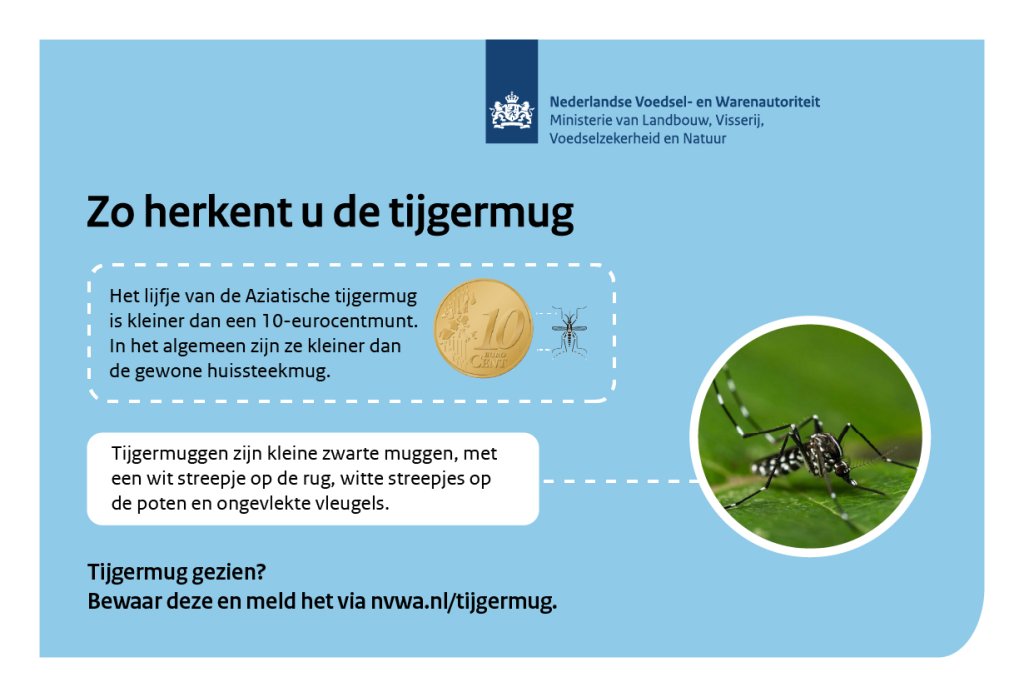
The Asian tiger mosquito is smaller than the common house mosquito and is black with distinctive white stripes on its body and legs. Do you think you’ve spotted an Asian tiger mosquito? Try to catch and keep the mosquito, and report your finding to the NVWA.
Have you seen a tiger mosquito? Save it and report it at www.nvwa.nl/tijgermug