Childcare Piggy Bank

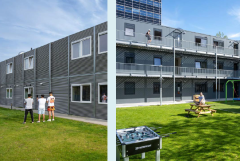
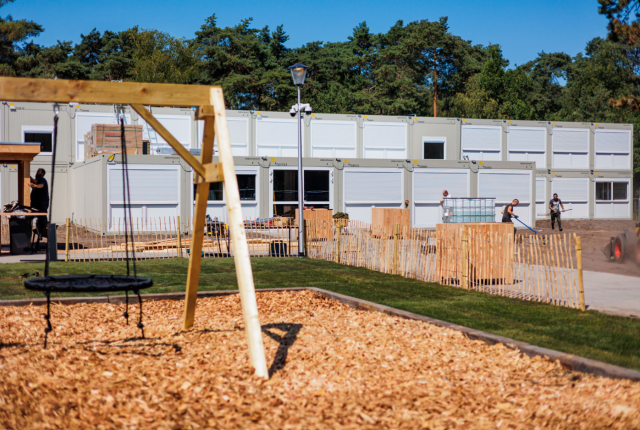
Example of units used as housing for unaccompanied minor asylum seekers

On September 1 of this year, the current shelter for unaccompanied minors in the Akert neighborhood will close. These are young people under the age of 18 who have come to the Netherlands without their parents (also known as AMVs).

The municipal council, in collaboration with the COA, has explored options for providing these young people with long-term, appropriate housing in the municipality. Unfortunately, no suitable location has been found in the municipality that can be used for an extended period.

Spaarpot previously served as a shelter

Establishing high-quality, permanent childcare takes time. The municipal executive therefore plans to set up temporary childcare on the vacant lot next to Spaarpot 135 for a maximum of three years, until a permanent location is found. This site was also used for temporary emergency childcare in 2024.

Participation and Decision-Making

We have invited local residents to a meeting to explain our plans to have these young people live here. The municipal executive’s proposal will be discussed at the General Affairs Committee meeting on Thursday, April 9. You are also welcome to speak at that meeting. More information is available on the Meetings webpage. The city council will vote on the proposal on Monday, April 20.

In addition to the municipal process, the COA must also conduct several assessments to determine whether the location is suitable as a temporary shelter. If the location is suitable and the municipality gives its approval, the temporary shelter can be established.

Location, supervision, and management of the shelter

The COA is responsible for the day-to-day care and support of the young people and is on site 24 hours a day. In addition, Nidos serves as the guardian for the young people and collaborates with organizations such as Humanitas, the Dutch Council for Refugees, and the municipality.

Social and inclusive goals

Geldrop-Mierlo is a socially conscious municipality committed to fostering an inclusive society. We believe it is important for young people to feel welcome, to integrate, and to participate. By promoting language skills, daily structure, participation, and engagement with the community, they build a sense of purpose, stability, and social integration. 

Frequently Asked Questions

Below, we have added frequently asked questions and answers about childcare at De Spaarpot.

Why wasn’t the local community consulted when the decision was made to house refugees here? Why weren’t business owners and residents given a say?

As a community, it is important to have a say. However, our municipality also wants to take responsibility for making a meaningful contribution to addressing the refugee crisis and fulfilling our legal obligation under the Distribution Act. It makes sense that residents feel caught off guard. That is why, even before the city council makes a final decision on additional guidelines, we have sent local residents and stakeholders an invitation to an information evening. With that information, the city council can make a well-considered decision.

Why do we have to organize childcare again?

The COA (Central Agency for the Reception of Asylum Seekers) has been struggling with a severe shortage of shelter spaces for some time now. All municipalities must do their part to help accommodate refugees. 

Geldrop-Mierlo has decided to organize permanent and appropriate housing for refugees to ensure that the demand for housing can be adequately met. The municipal government also considers it important that this housing be provided in a manner that respects human dignity and is organized in a socially responsible way that takes the local community into account.

Why can't the daycare center stay in the Akert?

The management agreement between Anna Zorggroep, the COA, and the municipality specifies an end date of September 1, 2026. This has also been consistently communicated to the local community (including the advisory group). The municipal executive considers reliable governance to be important. That is why we have begun searching for a location in another neighborhood of Geldrop or Mierlo. 

Why does Geldrop-Mierlo accept asylum seekers when some of its residents clearly indicate mixed feelings about this?

Geldrop-Mierlo is a municipality for everyone. The municipal executive and the city council consider it a moral responsibility to contribute to the reception of asylum seekers. With the introduction of the Distribution Act, we are also required to take in asylum seekers. At this time, we are not yet in compliance with this requirement.

Refugees are allowed to live there, but I can’t get permission for my family.

Only existing staff housing is permitted on the industrial park. No new housing may be added. Consequently, no permanent refugee shelter will be established. This shelter is temporary in nature and will operate for a maximum of three years.

There are also migrant workers living there. Is that allowed?

It is known that some staff housing units are occupied by migrant workers. Fire safety in these buildings is up to standard. The residents—who are migrant workers—mostly work at companies located at De Spaarpot.

Where are these young people from?

The current shelter for these unaccompanied minors in the Akert neighborhood will close on September 1 of this year. We made that agreement with the neighborhood three years ago, and we intend to honor it. Beyond our legal obligation, we would like to keep this group of young people within our municipality. They attend school in our region (Helmond) and have often already established roots in our municipality through community activities and part-time jobs. 

Together with the COA, we have explored options for finding permanent housing for these young people. Unfortunately, we have not (yet) been able to find a place that will be available for at least five years.

What if we are unable to welcome the young people to this location on September 1?

There is a good chance that the temporary shelter will not be ready by September 1, 2026. We want to avoid having to relocate the current group of unaccompanied minor asylum seekers to shelters elsewhere in the country. It has been agreed with the COA that, in that case, the 54 unaccompanied minor asylum seekers—who are currently staying at the De Akert reception center—will be temporarily relocated to a hotel or vacation park in our municipality or the region. As soon as the temporary reception center at the Spaarpot is ready, the unaccompanied minor asylum seekers can move there. Continuity of education and integration will then remain guaranteed.

How long will these young people stay in Geldrop?

This group of young people (boys and girls aged 15, 16, or 17) are staying here while awaiting their asylum proceedings. These children, mainly from Eritrea, Somalia, and Syria, have come here in distress. Along the way, they have endured terrible experiences, such as human trafficking. They recently arrived in Ter Apel (Groningen). There, they undergo a medical examination, must register, and have an intake interview where they are given an explanation of the shelter and the house rules. Afterward, they are distributed among “process reception locations for unaccompanied minors” such as the Spaarpot to await their proceedings. 

Once the IND has made a decision (whether positive or negative) on the asylum application, the young person is always transferred to another location. Asylum seekers who have exhausted all legal remedies also do not remain at this location. The processing time for the procedure is normally between nine and twelve months. However, this also depends on the IND’s capacity.

Why was this shelter chosen?

In 2024, we previously operated a temporary shelter for 150 refugees at the Spaarpot for three months. This proved to be an excellent location, both for the local community and for the refugees. Collaborations with community organizations and the surrounding neighborhoods have emerged thanks to active support from LEVgroep. LEVgroep is already in contact with the young people in the Akert, which means this collaboration can continue at the new location as well.

Why not use the piggy bank anymore?

We want to be a reliable government for our citizens. This commitment is set out in writing in the administrative agreement we have entered into with the COA. We are committed to this now and will remain so in the future. In addition, our municipality has other goals, including the development of industrial parks. We are committed to those as well. 

We’ve noticed lately that the COA isn’t vacating the shelters on time. Doesn’t that pose a risk that we’ll end up having to keep this shelter open longer?

We do indeed see that, due to the shortage of accommodation spaces, the COA is having difficulty closing existing facilities where the agreements are expiring. By now demonstrating—both on our part as the municipality and on the part of the COA—that we are closing De Akert, but are working together to find a solution, we want to make it clear that we, as well as the COA, are honoring our agreements. In addition, during the time that the COA remains at De Spaarpot, we will work together with the COA to find a long-term solution within our municipality. 

Who can I contact if I have concerns about this daycare?

To ensure effective and regular communication between local residents, the COA, and the municipality, a feedback group will be established. We have had positive experiences with this approach in the Akert. The feedback group consists of representatives from the municipality, the COA, and local residents. We discuss issues and concerns and consult on what is needed to ensure that everything runs as smoothly as possible. We will continue to do this throughout the entire reception period.

Anyone interested in joining the advisory group should contact the municipality or the COA site manager.

How many asylum seekers is the municipality required to accommodate under the Distribution Act?

Under the Distribution Act, the municipality has been assigned a quota of 137 refugees, including 54 unaccompanied minor foreign nationals. This number is expected to rise. The Province will announce its allocation decision in October.

Will the municipality of Geldrop-Mierlo realize them?

We have always stated our commitment to taking responsibility for this social challenge. We therefore certainly intend to address this challenge. With the enactment of the Distribution Act, we are also legally required to do so. More information about this law and the requirements municipalities must meet can be found on the rijksoverheid’s website at . 

Are any other locations known yet?

No. In March 2025, the city council established guidelines for organizing appropriate housing for refugees. We are searching for the best possible location(s). Both multiple small-scale and a larger reception facility are possible, provided they fit within the refugee reception framework. In addition, the municipal government considers it important that reception takes place in a humane manner and that it is organized in a socially responsible way for the surrounding community.

What if municipalities did not set up these shelters?

There is currently a shortage of about 15,000 spots nationwide. In reality, the number is higher due to high occupancy rates (over 100%) at these facilities. If facilities close and no new ones open, these people will end up on the streets. The result is that these people will start appearing on the streets. They will wander, sleep on the streets, and search for food and other means of survival. Residents would experience far more disruption and nuisance from this than from the solution we are now proposing.

How is supervision at the residential site arranged?

The COA residential facility has a site manager. The COA also guarantees support 24 hours a day, 7 days a week. There are certified emergency response officers on site. Every child has a mentor from the COA and their own guardian from Nidos. In addition, there is round-the-clock security on site. So there is a great deal of supervision for this vulnerable group. We can see that this supervision works at De Akert.

Are young people allowed off the grounds?

Yes, like all young people, they are allowed to go outside. They also just go to school for example. However, the rule is that they must physically report to the reception location twice a day. COA organizes activities at the location so that young people are motivated to stay at the location.

How are nuisances prevented at the residential site?

The COA informs the young people about the house rules at the housing facility. The COA also provides some orientation. The young people are taught about manners, values, and norms, as well as behavioral and traffic rules in the Netherlands. The community police officer visits regularly to check in on how things are going and to talk with the young people. If the young people break the rules, there are consequences, just as there would be in a typical household.

How is public order and security managed?

The COA is responsible for ensuring the quality of life, order, and safety at the reception center. The site manager and staff monitor safety and the quality of life at the center 24 hours a day. In addition, security personnel are on duty around the clock. To this end, the COA has contracted the private security firm Trigion.

In the event of criminal offenses or disturbances of public order, the police are called in. The police also include the reception center and its surroundings in their patrols. Furthermore, there are regular consultations between the COA, the community police officer, and the municipality to discuss concerns raised by residents and take appropriate action if necessary. To this end, the community police officer, area director, and special investigating officer maintain close contact with residents living in the vicinity of the Spaarpot.

Where can residents go if they have concerns or complaints?

COA has a telephone number 06 29 085 167 on which the residential location can be reached 24 hours, 7 days a week. There is also the national police number (0900-8844) and for emergencies, 112.

There is also close and regular communication between local residents, the COA, and the municipality to discuss issues, concerns, and solutions. Local residents are also involved prior to the facility’s opening to ensure the best possible integration. After the facility opens, consultations with local residents and business owners (focus group) will continue. This way, we can continue to monitor how things are going in the neighborhood and how the young people can integrate successfully.

Still have questions?

We understand that you may have questions about issues such as safety, quality of life, and the impact on the neighborhood. You can contact us by calling 040 289 38 93 or byemailing opvangspaarpot@geldrop-mierlo.nl.