
After 36 years in politics, Alderman van de Laar is taking a break, not retiring
“If you run this house, you have to serve on the front lines; it’s ‘yes, unless,’ not ‘no, provided that’!”
Just a little while longer, and the formation process will be over. In early June, the new municipal council of Geldrop-Mierlo will be officially installed—without Mierlo native Hans van de Laar. After 36 years in local politics, Alderman van de Laar (76) is stepping down. Well, “stepping down”… he thinks that word sounds far too dramatic. It’s a bit like he’s heading off to spend his days in the geraniums with a gold watch under his arm. That’s not how he is. “I’d rather step aside than disappear,” he says with a grin. “Quit completely? No way. There’s a good chance I’ll become chairman of the party (DPM). So I’ll still be around somewhere.”
Still, there’s a faint glimmer of something new on the horizon: peace and quiet. Or at least an attempt at it. “Not always on the go for a change. I just don’t know how long I can keep it up. It’s not really in my nature.”
Quite a big mouth
His political career didn’t really take off until he was around forty. It wasn’t the result of a carefully laid-out career plan, but rather of his commitment and strong opinions. “Especially the latter,” he admits with a laugh. “I had quite a big mouth back in Mierlo. At some point, I thought: maybe I should channel that energy into something where it actually makes a difference.”
But if you look back, you’ll see that the foundation was laid much earlier. Long before the city council came into the picture, there was the village itself—and a newcomer who quickly felt at home there.
An Instant Resident of Mierlo
Born in Helmond, he moved to Mierlo in 1974 and felt at home there almost immediately. “I was a Mierlo native right away,” he says with a smile. Before he had even settled in properly, he was already involved in community life and had taken a seat at various board tables. “I’m just not the type to sit still.” One of his first achievements: a billiards club at the Mona Lisa bar. To his own surprise, that club is still going strong more than half a century later. “52 years,” he says, “nobody would have thought that back then. Certainly not us.” He also became a member of the parade committee for the carnival association De Kersenpit and served for years as an “unofficial” wedding officiant at the Spruwwejagers’ Farmers’ Wedding.
Idealism with a frothy head
Through Café ’t Breujke, he eventually ended up at OJC PoerVoe, Mierlo’s first real youth club. What started as just a little help ended, as is often the case with him, with him joining the board. And eventually, he even became president. At PoerVoe, everything revolved around a holy trinity: music, volunteer work, and beer sales. The latter, in particular, proved to be essential.
Mierlo has sponsored pop history
“Without a large subsidy, artists had to be paid mostly out of bar revenue. So a full house wasn’t a luxury, but a necessity. If the bar was doing well, we could book bigger acts,” he says dryly. And that worked better than anyone could have hoped: a converted cow barn hosted acts that would later become big names, such as Doe Maar, Herman Brood & His Wild Romance, Golden Earring, The Scene, The Nits, Rosa King, Barrelhouse, and Bertus Borgers. Often even before their national breakthrough. “So basically, half of Mierlo sponsored Dutch pop history through beer consumption,” he grins.
Entering politics
Together with Alderman Lammers (father of the then-young Frank Lammers, ed.), he was also one of the initiators behind the founding of the Mierlo Welfare Promotion Foundation. This led to the creation of the ’t Saam Village Workshop and the MFA Foundation. “We had a good relationship with the municipality, but felt there was still much room for improvement in the area of welfare. The move into politics was really a logical one.” Cees Backx, then party leader of the Mierlo Village Party, asked him to join the electoral list. “The rest is history,” he laughs. “I actually just stayed on.” That “staying on for a while” eventually turned into 28 years as a council member and then another 8 years as Alderman.
YouAlderman never just Alderman
As Alderman , he Alderman never just half-committed.Alderman 24/7Alderman . You’re always on duty. Even at the supermarket, you’ll run into a traffic situation, a loose sidewalk tile, or a dog-poop problem.” Looking back, he mentions several portfolios he’s proud of. But public spaces stand out above all. “Road maintenance, for example—that was a real challenge eight years ago when I took office. We’ve made huge strides there. And the installation of fiber-optic cable: we were a blank spot in the region. I couldn’t explain that. But we pulled it off.” He nods with satisfaction. “Those kinds of things stick with you.”
Showpieces and downpours
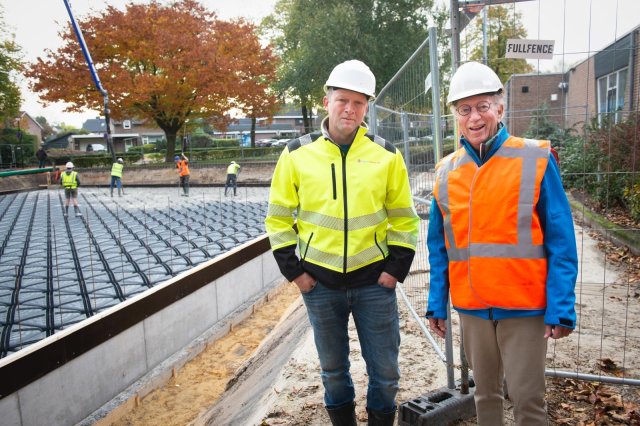
He also cites water storage as a key issue. It’s not exactly the kind of topic that gets people talking at birthday parties, but it is essential. “That remains important. The climate is changing, the earth is warming up, so this isn’t going to stop.” He sees the so-called Blue Vein Plan as an investment in the future. And he refers to the water cellar next to De Weijer Sports Hall with appropriate pride as a ‘showpiece’. “There’s even national interest in it. I’m now confident enough to handle a heavy downpour.”
Mobility also remains a concern for him. “It all starts with accessibility. The A67, overpasses, traffic congestion… in some parts of the municipality, traffic is already coming to a standstill.” He doesn’t expect to suddenly let go of that issue after he leaves. “I’ll definitely keep an eye on that.”
You eat an elephant one bite at a time
Anyone who has been in a leadership role for years learns to deal with frustration. Or at least tries to. “What has really gotten to me at times is how long everything takes,” he says. “We have a lot of rules. Understandable at times, but things could certainly move a bit faster.” He laughs briefly. “That’s tough when you’re naturally impatient.” Over the years, he has therefore developed his own administrative philosophy. “You have to eat an elephant one bite at a time.” A moment of silence. But then one last piece of advice. “Everything seems big and complicated. But you have to make it manageable. Just start. Step by step. Do what you can do and then move on. If you run this house, you have to serve on the front lines. It’s ‘yes, unless.’ Not ‘no, unless.’”
Worries about what's to come
There are also concerns. Mainly financial ones. “It’s going to be really complicated for my successor. No money, no tasks. Everything is getting more expensive. The costs are skyrocketing.” He lists them off as if he were still in the middle of a council meeting. “Network congestion, CO₂ regulations, rising costs, youth care… it’s all piling up. We’re a municipality with a village character but with an urban challenge and the associated costs. That’s where the problem lies. We’re running out of levers to pull.”
Eight years is enough
The fact that he’s stepping down as Alderman now was actually a foregone conclusion for him from the very start. “I’ve always said: eight years is enough.” Why? “Because otherwise, as Alderman , you get Alderman involved in the day-to-day operations. Then you start meddling in everything. You have to keep your role clear.” He isn’t leaving entirely without a care. “No, there are issues I would have liked to see through to the end. Too much is happening for that. But it’s all right, Sun.
What now?
The future isn’t over yet. It doesn’t seem like it’s going to be a full stop. More like a comma. His wife, Ineke, already has plans. “More city trips,” he says with a smile. “And I’m a huge fan of the mountains in Austria. I’d love to drive over a mountain pass again.” Old hobbies are making a comeback, too. “I still do a bit of programming now and then. And I’m going to learn Spanish!”
Then, almost as a summary: “I recently turned 76… 28 years on the city council, 8 years Alderman. It’s all still sinking in.” A smile. “It’s been a good run. But I’m not done yet.”